Search This Blog

Wednesday, 23 October 2013

Mazda RX-7


The Mazda RX-7 is a sports car produced by the Japanese automaker Mazda from 1978 to 2002. The original RX-7 featured a 1,146 cc (69.9 cu in) twin-rotor Wankel rotary engine and a front-midship, rear-wheel drive layout. The RX-7 replaced the RX-3 (both were sold in Japan as the Savanna) and later replaced all other Mazda rotary-engine cars except the Cosmo.
The original RX-7 was a sports car with pop-up headlamps. The compact and lightweight Wankel rotary engine is situated slightly behind the front axle, a configuration marketed by Mazda as "front mid-engine". It was offered as a two-seat coupé, with optional "occasional" rear seats in Japan, Australia, the United States, and other parts of the world. The rear seats were initially marketed as a dealer-installed option for the North American markets.
The RX-7 made Car and Driver magazine's Ten Best list five times. 811,634 RX-7s were produced.[1]


Sunday, 13 October 2013

Mitsubishi Lancer Evolution


The Mitsubishi Lancer Evolution, also known as the Evo,[1] is a high-performance sports car manufactured by Mitsubishi Motors that is based on the Lancer. There have been ten official versions to date, and the designation of each model is most commonly a roman numeral. All use two litre, turbocharged engines and all-wheel drive systems.[2]
The Evolution was originally intended only for Japanese markets, but demand on the "grey import" market led the Evolution series to be offered through Ralliart dealer networks in the United Kingdom and in various European markets from around 1998. Mitsubishi decided to export the eighth generation Evolution to the United States in 2003 after witnessing the success Subaruhad in that market with their long-time direct rival, the Subaru Impreza WRX.[3]
Japanese-spec cars were limited by a gentlemen's agreement to advertise no more than 280 PS (206 kW; 276 hp), a mark already reached by Evolution IV. Therefore, each subsequent version has unofficially evolved above the advertised power figures, with the Japanese-spec Evolution IX reaching an alleged output of around 321 PS (236 kW; 317 hp). Various versions available in other markets, particularly the UK, have official power outputs up to 411 PS (302 kW; 405 hp). Today, the Evo is very popular among the street racing scene.
The tenth generation of the Lancer Evolution was launched in Japan 2007, and overseas markets in 2008.

Friday, 11 October 2013

SLS AMG Coupé Black Series (2013)


SLS AMG Coupé Black Series is a version of SLS AMG Coupé inspired by the racing version of the SLS AMG GT3. It includes increased engine power to 464 kW (622 hp) and 635 N·m (468 lb·ft), increased engine's redline to 8000 rpm, fully revised high-speed valve train with modified camshafts, adapted cam geometry and optimised bucket tappets featuring a special coating which is otherwise exclusive to racing vehicles, modification of the intake air ducting (derestriction and adaptation to the new maximum engine speed), adaptation of the engine application and increase in peak pressure.
The vehicle is 70 kg (150 lb) lighter than the standard model. This is accomplished by increased use of carbon fibre in body panels, mechanical components, and the spaceframe. Further, a switch from steel to titanium for the exhaust reduces weight by 13 kg (29 lb). The use of lithium-ion battery reduces weight by 8 kg (18 lb).
The AMG SPEEDSHIFT DCT 7-speed sports transmission is installed 10mm lower in order to achieve a lower centre of gravity for the vehicle and is braced against the body by gas-filled struts in order to avoid stress cycles. The transmission's "Sport plus" and "Manual" modes feature faster shifting speed. The downshifting throttle blips are more audible. The new temporary M mode enables the driver to activate manual mode without having to remove a hand from the steering wheel, by pressing the "up" or "down" shift paddle once.
Other features include electronically controlled AMG rear-axle differential lock with a shorter rear-axle ratio, new AMG RIDE CONTROL performance suspension (tauter basic tuning and electronically controlled two-stage damping, coil-over spring retainers to enable adjustment of wheel loads, elastokinematics 50 / 42% more rigid (front/rear axle), track width increased by 20 / 24 millimetres (front/rear axle), new wheel carriers on front axle and new front stabiliser tuning, matte black with high-sheen AMG 10-spoke light-alloy wheels in particularly light forged design with optimised strength (10x19-inch front, 12x20-inch rear), Michelin Pilot Sport Cup 2 sports tyres (275/35 R 19 front, 325/30 R 20 rear), AMG speed-sensitive steering with newly defined power steering characteristic), AMG ceramic brake discs (402 x 39 millimetres front and 360 x 32 millimetres rear) with increased hardness, wide flared wings with an added width of 13 mm (front) and 26 mm (rear) on each side, darkened headlamps and black surrounds for the rear lights, front apron and rear apron with diffusor along with side sill panels in Black Series-specific design (carbon fibre-reinforced plastic front splitter, carbon inserts in the side sills and the rear apron made of carbon fibre, enlarged air intakes with carbon-fibre flics), carbon-fibre bonnet with central air outlet, Alcantara black or Alcantara black/red interior AMG Performance steering wheel with Alcantara upholstery, metal bezel features a high-gloss black paint finish to match the high-gloss black surrounds of the air vents, Alcantara strip in anthracite across the entire width of dashboard leather with red contrasting stitching in the leather, designo leather and Alcantara upholstery (including bottom section of the dashboard, door centre panels and on the AMG sports bucket seats in Alcantara), deleted COMAND APS multimedia system replaced by a carbon-fibre trim element (COMAND APS is optionally available), AMG DRIVE UNIT, red seat belts and red contrasting stitching on the AMG sports bucket seats, the upper and lower section of the dashboard and the door panelling; floor mats with red edging, optional Bang & Olufsen BeoSound AMG surround sound system.
Optional AMG Aerodynamics package includes a fixed adjustable carbon-fibre rear aerofoil in the style of the SLS AMG GT3, rear aerofoil braced by aluminium elements on a special insert on the boot lid, additional carbon-fibre flics on the front apron. New body colour choice include AMG solar beam (total 7, including matte paint designo magno alanite grey)
Other options include AMG carbon-fibre exterior mirror, AMG carbon-fibre engine cover, AMG Interior Carbon-Fibre package, AMG infotainment system (incl. COMAND APS, AMG Performance Media and backup camera), Media Interface.
The vehicle was unveiled in 2012 LA Auto Show,[54][55] with market launch set to begin in June 2013.[56]
US model set to go on sale on summer 2013 as 2014 model year vehicle.[57]

Sunday, 6 October 2013

2JZ-GTE


The 2JZ-GTE is an inline-layout, six-cylinder, belt-driven dual-overhead camshaft, air-intercooled, twin-turbocharged, cast-iron block, aluminium cylinder headed engine designed and manufactured by Toyota Motor Corporation that was produced from 1991 until 2002 in Japan. Development and evolution of the engine was, principally, a response to Nissan's relatively new and then-successfulRB26DETT engine[citation needed] which had achieved palpable success in FIA Group A and Group N touring car championships,
For all road car applications, two gearboxes were available for the engine:
  • Toyota A341E 4-speed automatic
  • Toyota V160 and V161 6-speed manual (jointly developed with Getrag as the Type 233)
The 2JZ-GTE originally powered the Toyota Aristo V (JZS147) in 1991 before becoming Toyota's flagship performance engine in theToyota Supra RZ (JZA80). Its mechanical basis was the existing 2JZ-GE, but differed in its use of sequential twin turbochargers and an air-to-air side-mounted intercooler. The engine block, crankshaft, and connecting rods of the Supra's 2JZ-GE and 2JZ-GTE are the same, with notable differences being that the 2JZ-GTE has recessed piston tops (giving a lower compression ratio), oil spray nozzles to aid in cooling the pistons and a different head (redesigned inlet/exhaust ports, cams and valves). However, other 2JZ-GE equipped models (Aristo, Altezza, Mark II) share a different part number for connecting rods. Toyota's VVT-i variable valve timing technology was added to the engine beginning in September 1997, whence it phased out the original engine. Consequently, maximum torque and horsepower was raised for engines selling in all markets.
The addition of twin turbochargers, jointly developed by Toyota with Hitachi, in sequential configuration had raised its commercially cited output from 230 PS (169 kW; 227 hp) to the contemporary industry maximum of 280 PS (206 kW; 276 hp) at 5600 rpm. In its first appearance, torque was advertised as 44.3 kgm (435 Nm, 320 lbft) at 4000 rpm to be later recited as 46.0 kgm (451 Nm, 333 lbft) with the introduction VVT-i in production year 1997. The mutually agreed, industry-wide output ceiling was enforced by Japan's now-defunctGentlemen's Agreement exclusively between Japanese automakers selling to the Japanese domestic market. Engine power in the North American and European markets, as documented by Toyota, was increased to 325 PS (239 kW; 321 hp) at 5600 rpm.[4]
The export version of the 2JZ-GTE achieved its higher power output with the use of newer stainless steel turbochargers (ceramic for Japanese models), revised camshafts, and larger injectors (550 cc/min for export, 440 cc/min for Japanese). The mechanical similarities between the Japanese-specification CT20 turbine and export-specification CT12Bturbine allow interchangeability of the exhaust-side propeller shaft. Additionally, the export-exclusive CT12B turbine received more durable turbine housings and stainless steel turbine and impeller fins. Multiple variants of the Japanese CT20 turbine exist discretely, which are identified with the BR, and A part number suffixes (e.g.: CT20A).
Applications:
  • Toyota Aristo JZS147 (Japan-only)
  • Toyota Aristo V300 JZS161 (Japan-only)
  • Toyota Supra RZ/Turbo JZA80

Wednesday, 2 October 2013

Toyota JZ engine


The 1JZ-GTE employs twin CT12A turbochargers arranged in parallel and blowing through a side-mount or front mount air-to-air intercooler . With an 8.5:1 static compression ratio, the factory quoted power and torque outputs are 280 metric horsepower (210 kW) at 6200 rpm and 363 newton metres (268 lbf·ft) at 4800 rpm respectively. The bore and stroke are the same as for the 1JZ-GE: 86 mm (3.39 in) bore × 71.5 mm (2.81 in) stroke. Yamaha may have had a hand in the development or production of these motors (possibly the head design), hence the Yamaha badging on certain parts of the motor, such as the cam gear cover. In 1991, the 1JZ-GTE was slotted into the all-new Soarer GT.
The early generation 1JZ-GTEs combined the inherent smoothness of an inline 6-cylinder engine with the revving capacity of its short stroke and early power delivery of its small, ceramic wheeled turbochargers. The ceramic turbine wheels are prone to delamination in the setting of high impeller rpm and local temperature conditions, usually a result of higher boost. The first generation 1JZs were even more prone to turbo failure due to there being a faulty one-way valve on the head, specifically on the intake cam cover causing blow-by gases to go into the intake manifold. On the exhaust side, a decent amount of oil vapor flows into the turbos causing premature wear on the seals. The later second generation engines had this problem fixed and in Japan there was actually a recall in order to repair the first generation engines, though that does not apply to 1JZs imported to other countries. The fix is simple, and involves replacement of the PCV valve (2JZ); all parts are available through Toyota.
The third generation of the 1JZ-GTE was introduced around 1996, still as a 2.5-litre turbo, but with Toyota's BEAMS architecture.[2]This included a reworked head, newly developed continuously variable valve timing mechanism (VVT-i), modified water jackets for improved cylinder cooling and newly developed shims with a titanium nitride coating for reduced cam friction.[3] The turbo setup changed from parallel twin turbo (CT12x2) to a single turbo (CT 15B). The adoption of VVT-i and the improved cylinder cooling allowed the compression ratio to be increased from 8.5:1 to 9.0:1. Even though the official power figures remained at 280 metric horsepower (210 kW) at 6200 rpm, torque was increased by 20Nm to 379 newton metres (280 lbf·ft) at 2400 rpm. These improvements resulted in increased engine efficiency that reduced fuel consumption by 10%. The adoption of a much higher efficiency single turbocharger than the twins as well as different manifold and exhaust ports were responsible for most of the 50% torque increase at low engine speeds . This engine was used primarily in Toyota's X chassis cars (Chaser, Mark II, Cresta, Verossa), the Crown Athlete V (JZS170) and in the later JZZ30 Soarer, as the JZA70 Supra was long discontinued by this time.

Monday, 30 September 2013

Chevrolet Corvette (C7)


The Chevrolet Corvette (C7) is a sports car being produced by the Chevrolet division of General Motors introduced for the 2014 model year. It is the seventh generation Chevrolet Corvette and the first to bear the Corvette Stingray name since the 1976 third generation model. It is expected to start delivery in the 3rd quarter of 2013. This new version will be available with right-hand drive in the UK market for the first time since Corvette was introduced in 1953.[3]


Fastest Cars in The World

1: Hennessey Venom GT, 260 mph (418 km/h), 0-60 mph in 2.5 seconds.

Our fastest car has a 6.2-liter LS9 Turbocharged V8 Twin Turbo V8 Engine producing 1200 hp, with a price tag of $950,000. The Venom GT has yet to be tested and proven, but could hit a top speed of 275 mph. This might just be the Veyron Super Sport’s closest challenger!.  This is the fastest car in the world after Guinness book of world record had declared that Bugatti veyron speed were manipulated. Thus pushing down Bugatti veyron to second rank in our list of top 10 fastest cars

2: Koenigsegg Agera R, 260 mph (418 km/h), 0-60 mph in 2.9 seconds.

5.0-liter V8 Engine with twin turbo’s, housing 1099 hp. Base price is $1,600,000. If you’re into snow sports, the Agera R can be fitted with a Ski Box as well as winter tires. While the Agera R has a massive theoretical top speed, the current tested top speed is 260 mph. Expect this snow car to be the Bugatti’s arch enemy for the next 5 years.This is the second in top 10 fastest cars.


3: Bugatti Veyron EB, 16.4 258mph 

(415.2)km/h

  Boasting a maximum speed of more than 400 km per hour, the Veyron is unmatched in the super sports category. It offers a total of 736 kW (1,001 HP), and its ample power reserves even at high speeds are the fabric of dreams for luxury-class limousines: for a constant speed of 250 km/h. The Veyron only needs 270-280 HP. This means that the seven-gear clutch transmission works with a torque of up to 1,250 Newton meters. The Electronic Stability Program ensures the necessary flexibility and maneuverability at any speed. The Veyron reaches velocities that would literally lift the car off the ground. If it were not for its ingenious aerodynamics, which keeps it firmly on the road even at full speed. Adjusting the back spoiler, reducing ground clearance, opening and closing the lids – it all adds to the perfect balance between propulsion and down force. Such a super sports car may not seem to be brought to a halt easily, but the Veyron’s ceramic brakes slow it down faster than it can accelerate. While it takes this exceptional car only 2.5 seconds to go from 0 to 100 km/h, it needs even less time – a mere 2.3 seconds – to come to a standstill from 100 (reference point). To cut the risk of injuries in accidents, Bugatti had a Formula 1 safety concept adapted for the Veyron. All these technical details combine to make the Veyron a truly exceptional super sports car. This is the third fastest cars in top 10 fastest cars list.

4: Saleen S7 Twin-Turbo, 248 mph (399 km/h), 0-60 in 2.8 seconds.

Twin Turbo All Aluminum V8 Engine with 750 hp, base price is $555,000. Smooth and bad-ass. It will make you want to show it off non-stop. This is the fourth in top 10 fastest cars.


5: Koenigsegg CCX, 245 mph (394 km/h), 0-60 in 3.2 secs.

90 Degree V8 Engine 806 hp, base price is $545,568. Made in Sweden, it is the older brother of the Agera R, only losing to 4 other supercars in the world. This is the fifth in top 10 fastest cars.


6. McLaren F1: 240 mph (386 km/h), 0-60 in 3.2 seconds.

BMW S70/2 60 Degree V12 Engine with 627 hp, base price is $970,000. The fastest car in the 20th century with doors that looks like bat wings. Maybe Batman needs to order one and paint it black.


7: Zenvo ST1: 233 mph (374 km/h), 0-60 in 2.9 seconds.

Twin-Charged 7.0 liter V8 Engine forging 1,104 hp. Base price: $1,225,000. The first Supercar from Zenvo Automotive, a Danish sports car company in pursuit of speed and perfection. This 100% Danish made supercar is limited to 15 units and the company even promised “flying doctors” to keep your baby functioning.


8: Gumpert Apollo: 225 mph (362 km/h), 0-60 in 3.0 seconds.

4.2 liter V8 Engine that houses 650 hp. Base price: $450,000. Gumpert claims that the Apollo was designed such that it could drive upside-down in a tunnel with speeds at 190 mph or above. Of course, no one has tested this yet.


Sunday, 29 September 2013

Nice Game


watch  the video


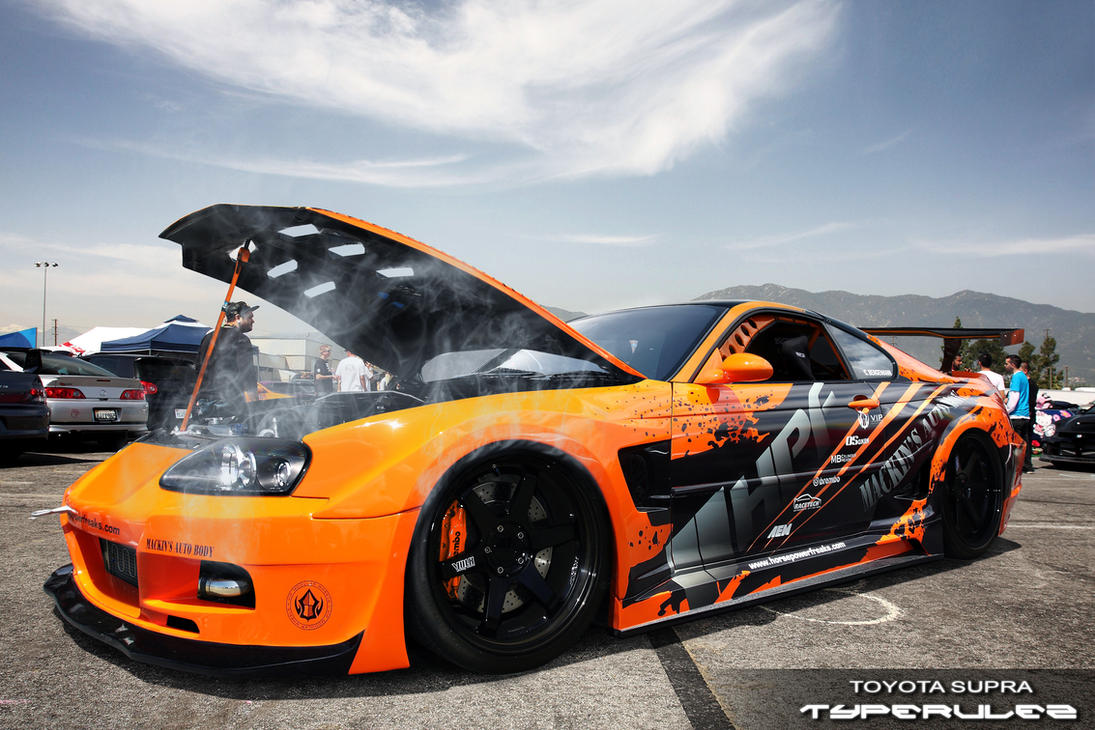
Toyota Supra


The Toyota Supra is a sports car/grand tourer that was produced by Toyota Motor Corporation from 1978 to 2002. The styling of the Toyota Supra was derived from the Toyota Celica, but it was both longer and wider.[4] Starting in mid-1986, the Supra (in its third generation, Mark III) became a separate model from the Celica. In turn, Toyota also stopped using the prefix Celica and began just calling the car Supra.[5] Owing to the similarity and past of the Celica's name, it is frequently mistaken for the Supra, and vice versa. First, second and third generation Supras were assembled at Tahara plant in Tahara, Aichi while the MKIV Supra was assembled at the Motomachi plant in Toyota City.
The Supra also traces much of its roots back to the Toyota 2000GT with the main instance being its engine. The first three generations were offered with a direct descendant to the Toyota Crown's and 2000GT's M engine. All four generations of Supra produced have an inline 6-cylinder engine. Interior aspects were also similar, as was the chassis code "A".
Along with this name and car Toyota also included its own logo for the Supra. It is derived from the original Celica logo, being blue instead of orange. This logo was used until January 1986, when the Mark III Supra was introduced. The new logo was similar in size, with orange writing on a red background, but without the dragon design. That logo, in turn, was on Supras until 1991 when Toyota switched to its current oval company logo. (the dragon logo was a Celica logo regardless of what color it was. It appeared on the first two generations of the Supra because they were officially Toyota Celicas. The dragon logo was used for the Celica line until it too was discontinued.)
In 1998, Toyota ceased sales of the Supra in the United States[5] and in 2002 Toyota officially stopped production of the Supra in Japan.
As an iconic sports car, the Supra has appeared in numerous video games, movies, music videos and TV shows. Some of the most notable appearances include the Grand Theft AutoGran TurismoForza MotorsportNeed for Speed, and Midnight Clubseries of video games and The Fast and the Furious film series.

Friday, 27 September 2013

Range Rover L405


Range Rover L405

The Range Rover L405, is the fourth-generation of Range Rover to be manufactured 
by Land Rover. It was first shown the 2012 Paris Motor Show.[2] It differs from previous generations by using an all-aluminium monocoque .body

Wednesday, 25 September 2013

Fast & Furious 6 Tank Car Chase


Fast & Furious 6 Tank Car Chase


Tuesday, 24 September 2013

Bugatti Veyron


 Bugatti Veyron


The Bugatti Veyron EB 16.4 is a mid-engined grand touring car, designed and developed by the Volkswagen Group and manufactured in Molsheim, France by Bugatti Automobiles S.A.S.
The Super Sport version of the Veyron is the fastest street-legal production car in the world, with a top speed of 431.072 km/h (267.856 mph).[4] The original version has a top speed of 408.47 km/h (253.81 mph).[5] It was named Car of the Decade (2000–2009) by the BBC television programme Top Gear. The standard Bugatti Veyron won Top Gear's Best Car Driven All Year award in 2005.
On 6 April 2013, Bugatti set the record for having the highest top speed of any roadster in the world with the Veyron Grand Sport Vitesse, reaching on average a top speed of 408.84 km/h (254.04 mph).[6][7]
The Veyron's chief designer was Hartmut Warkuss, and the exterior was designed by Jozef Kabaň of Volkswagen, with much of the engineering work being conducted under the guidance of engineering chief Wolfgang Schreiber.
A number of special variants have been produced. In December 2010, Bugatti began offering prospective buyers the ability to customize exterior and interiors colours by using the Veyron 16.4 Configurator application on the marque's official website.[8][9]

  watch the video  

Monday, 23 September 2013


Audi R8

The Audi R8[5] (Typ 42)[7] is a mid-engine, 2-seater sports car,[5][8] which uses Audi's trademark quattro permanent all-wheel drive system.[5][9] It was introduced by the German automaker Audi AG in 2006.
The car was exclusively designed, developed, and manufactured by Audi AG's high performance private subsidiary company,quattro GmbH, and is based on the Lamborghini Gallardo platform.[10] The fundamental construction of the R8 is based on theAudi Space Frame,[5] and uses an aluminium monocoque which is built using space frame principles. The car is built by quattro GmbH in a newly renovated factory at Audi's 'aluminium site' at Neckarsulm in Germany.[5]
In 2005, Audi announced that the name of the successful Audi R8 race car would be used for a new road car in 2007, the Audi R8, based on the Audi Le Mans quattro concept car (designed by Frank Lamberty and Julian Hoenig), appearing at the 2003International Geneva Motor Show, and 2003 Frankfurt International Motor Show. The R8 development program began in 2004, Lamberty's design being approved and frozen for production. Production body prototypes began field testing in January 2006. The R8 road car was officially launched at the Paris Auto Show on 30 September 2006. There was some confusion with the name, which the car shares with the 24 Hours of Le Mans winning R8 Le Mans Prototype (LMP). 6-time 24 Hours of Le Manswinner Jacky Ickx described the R8 as "the best handling road car today

Ken Block

Ken Block

 (born November 21, 1967)[2] is a professional 
rally driver with the Hoonigan Racing Division, formerly known as theMonster World Rally Team. Block is also one of the co-founders and recently appointed Chief Brand Officer of DC Shoes.[1] Block has also competed in many action sports events including skateboardingsnowboarding
 and motocross

Sunday, 22 September 2013

Top 10 Most Expensive Cars of 2013


Most of us spend a good deal of money on our vehicles, which we use every day for various activities. The value of a car to some is priceless, but what is the most you would spend on a car? Probably not as much as these cars cost. Check out the top ten most expensive cars of 2013. Coming in at number ten is, the McLaren F1 at 9.70K. Nine is the Hennessy Venom GT Spyder at 1.1M. Eight, the Zenvo ST1 at 1.2M. Seven, is the Maybach Landaulet at 1.38M. Six is tied between the Koenigsegg Agera R & Lamborghini Reventon at 1.6M. Five is tied between the Aston Martin One 77 & Pagani Zonda Cinque Roadster at 1.85M. Four, is the Bugatti Veyron Super Sports at 2.6M. Three, is the Lykan Hypersport at 3.5M. Number two, is the Lamborghini Veneno at 3.9M. And the number one spot goes the Maybach Exelero at an astounding 8.0 Million dollars. (Pictured below in this order


Best Car Drifting Ever


Best Car Drifting Ever


Nissan 

{ 350z }


2009 Nissan 370Z
Nissan Z34 Fairlady eed manual transmission which features the world's first synchronized down shift rev-matching system, SynchroRev Match. The SynchroRev Match system is only available with the sports package. The differential offered with the Sport Package is indicated to be a viscous limited slip differential. The new driveshaft is made from a carbon-fiber composite material.
Compared to the 350Z, the 370Z has a wheelbase 4 in (100 mm) shorter at 100.4 in (2,550 mm) and an overall length 2.7 in (69 mm) shorter at 167.1 in (4,240 mm). The overall width has been increased by 1.3 in (33 mm), the rear track by 2.2 in (56 mm), and overall height reduced by 0.3 in (7.6 mm). The smaller exterior dimensions and use of more lightweight materials help reduce weight. (Although it should be noted that a 2003-2005 base model 350Z is actually lighter than the 370Z, since Federally-mandated safety features add weight to models produced after 2008).
The 370Z features a front aluminum subframe, aluminum-alloy engine cradle, aluminum door panels, an all-aluminum hood, and an aluminum hatch. Front body torsion rigidity is improved by 10 percent with an extensively revised body structure which includes a new front suspension cradle to reduce front body lateral bending, new rear structural reinforcements, and an underbody "V-bar" to help reduce rear lateral bending. Rear body torsion rigidity is improved by up to 22 percent and rear body vertical bending rigidity is improved by up to 30 percent. Additional enhancements include the use of a carbon fiber composite radiator housing and strengthening of the rear fender and hatch areas. The new structure weighs slightly less than the 350Z.
The 370Z uses a front double wishbone suspension, with forged aluminum control arms and steering knuckle, the rear multi-link suspension uses a forged aluminum upper control arm, lower arm and radius rod, the toe control rod is steel and wheel carrier assembly is aluminum.[5] The refreshed 2013 model uses new dampers with the Sport package models. The brakes have been changed from the more expensive Brembo racing brakes to Nissan branded brakes which are manufactured by Akebono.
The coefficient of drag is 0.30 and 0.29 with the Sport Package, figures identical to the 350Z.

Saturday, 21 September 2013


Race Driver: Grid  released in North America as simply Grid, is the most recent addition to the TOCA Touring Car series, which is published and developed by Codemasters. The game is available for Microsoft WindowsPlayStation 3 and Xbox 360, and was released in Europe on 30 May 2008, in North America on 3 June 2008 and in Australia on 12 June 2008. The Mac OS X version of the game was released by Feral Interactive on March 28, 2013.[4]